

The Stamoli Advantage
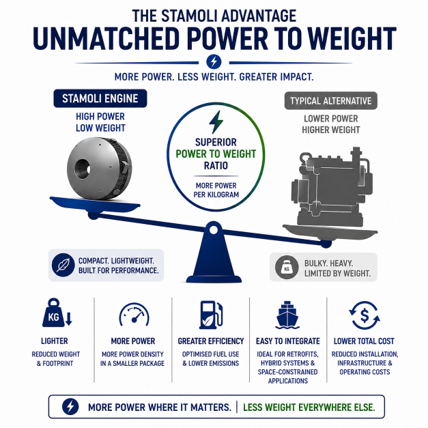
HIGH POWER TO WEIGHT RATIO.
The Stamoli power unit is being developed to deliver exceptionally high-power density from a compact and lightweight architecture. Its rotary operating principle, contiguous combustion events, and simplified mechanical configuration are intended to support substantial power output while reducing overall system mass and packaging volume compared with conventional engine platforms. This high power-to-weight approach may provide significant advantages across automotive, marine, stationary power generation, and specialist applications where performance, efficiency, payload capacity, and installation flexibility are critical operational requirements.
FUEL-FLEXIBLE PLATFORM.
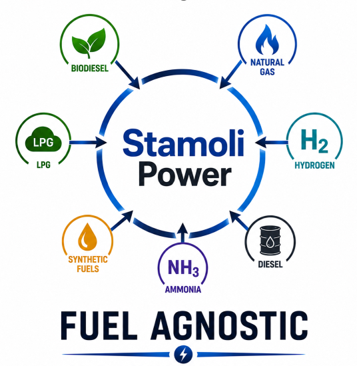
The Stamoli power platform is being developed as a fuel-flexible platform capable of supporting multiple energy pathways through its adaptable combustion architecture and fixed-speed operating strategy. The system is intended to accommodate evolving fuel technologies while maintaining efficient and stable power delivery across a wide range of operating applications. This flexibility is designed to support long-term adaptability in response to changing energy infrastructure, regulatory requirements, and sector-specific operational demands, providing a platform capable of transitioning alongside conventional, synthetic and low-carbon fuel strategies.
REDUCED TOTAL COST OF OWNERSHIP.
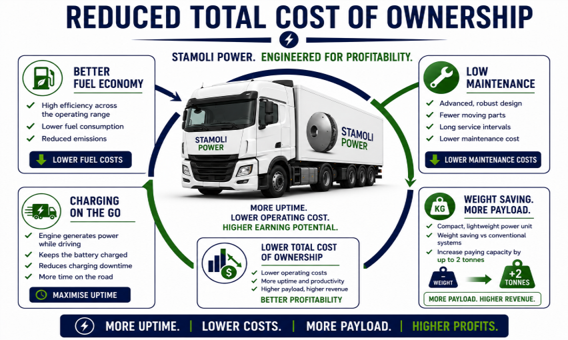
The Stamoli power unit is being developed to support significant reductions in total cost of ownership for commercial vehicle operators, particularly within heavy goods vehicle applications. Its compact lightweight architecture, high-efficiency fixed-speed operation and hybrid range-extender configuration are intended to reduce fuel consumption, minimise dependence on large battery systems, and improve operational flexibility. Continuous onboard charging capability would reduce vehicle downtime and depot charging infrastructure requirements, supporting faster fleet turnaround times. The simplified mechanical architecture and modular design philosophy are also intended to support reduced maintenance complexity, extended operational life, and improved long-term asset utilisation across demanding commercial transport duty cycles.
ORIENTATION INDEPENDENCE.
The Stamoli power unit is designed with an orientation-independent architecture enabled by its sealed lubrication system and rotary operating principle. Unlike conventional piston engines that rely on gravity-fed oil management systems, the Stamoli power unit’s compact rotary configuration supports flexible installation across multiple spatial orientations while maintaining stable lubrication and operational performance.
This architectural flexibility provides significant packaging advantages across automotive, marine, stationary power generation, and specialist vehicle applications, supporting improved system integration, lower centre-of-gravity opportunities, and greater freedom in platform layout configuration.
MODULAR POWER.
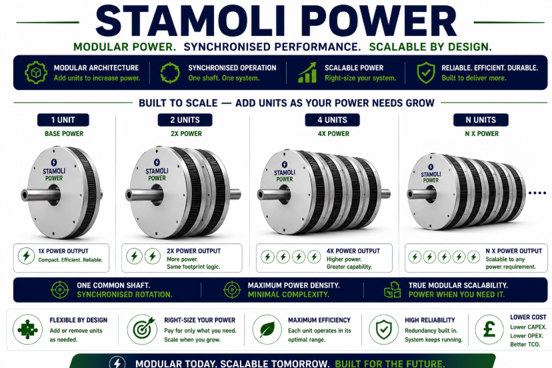
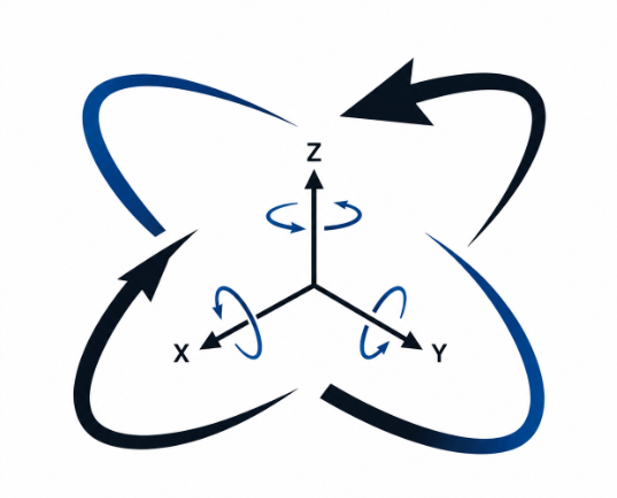
The Stamoli power unit is designed with a modular shared-shaft architecture that enables multiple power units to operate in synchronisation on a common rotational axis. This phased configuration supports scalable power output, smooth contiguous torque delivery, and enhanced rotational stability while maintaining a compact overall system footprint. The architecture is intended to provide flexibility across automotive, marine, stationary power generation, and industrial applications, allowing power systems to be configured to suit specific operational requirements. By combining multiple synchronised power modules on a single shaft, the platform is intended to support high-power applications while retaining the benefits of modularity, redundancy potential, and simplified system integration.
PRAGMATIC TRANSITION TO DECARBONISATION.
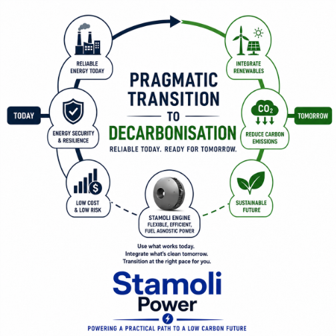
The Stamoli engine is being developed to support the practical transition toward reduced exhaust emissions and lower-carbon energy systems through a combination of high-efficiency operation, fuel-flexible capability, and compact power generation architecture. Rather than relying on a single future energy pathway, the platform is intended to provide adaptable solutions capable of supporting evolving regulatory, infrastructure, and operational requirements across multiple industries. Its fixed-speed efficiency optimisation and modular design philosophy are aimed at improving energy utilisation while supporting progressive decarbonisation strategies in transport, power generation, marine and industrial applications.