

Our Technology
The Stamoli Power Unit

The Stamoli cycle is fundamentally a different pressure profile from conventional reciprocating engines. During combustion, the working chamber volume between the rotor and stator remains effectively constant, meaning pressure behaviour is governed primarily by combustion dynamics and system leakage rather than piston-driven volume expansion.
In this configuration, leakage becomes the principal mechanism of pressure decay, similar to blow-by in a conventional piston engine. As a result, sealing performance and manufacturing precision are critical to maintaining high mean effective pressure (MEP), which directly influences torque and overall engine efficiency.
The absence of pistons, connecting rods, and crankshaft also substantially reduces opposing inertial and reciprocating mechanical forces, contributing to lower mechanical losses and smoother torque delivery.
CLOSE TO ISOCHORIC
EXTENDED HIGH PRESSURE DWELL
HIGHER EFFECTIVE WORK OUTPUT
BENEFITS OF BEING CLOSE TO ISOCHORIC
HIGHER EFFICIENCY
Closer to the theoretical maximum

BETTER FUEL ECONOMY
More kilometers or hours per mile
BUILT FOR RELIABILITY
Optimized performance within practical limits

LOWER EMISSIONS
More complete combustion with less waste

MORE POWER
More work output from the same fuel

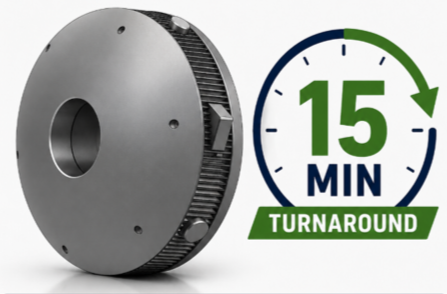
Rapid Replacement.
MINIMUM DOWNTIME, BACK IN SERVICE FAST
The Stamoli power unit is being developed with a strong focus on serviceability, maintainability, and operational uptime. Its simplified mechanical architecture, reduced component count, and modular design philosophy are intended to minimise maintenance complexity and significantly reduce vehicle and equipment downtime compared with conventional engine platforms. Rather than requiring extended workshop intervention involving large numbers of moving parts and complex disassembly procedures, the architecture is being designed to support rapid inspection, simplified servicing and fast module replacement strategies. The objective is straightforward, reducing maintenance events from days or weeks to potentially minutes or hours, helping operators maximise asset availability and operational productivity.
SMARTER DESIGN, STRONGER VALUE.
ENGINEERED FOR REAL-WORLD RESULTS.
BUILT FOR RELIABILITY, DESIGNED FOR THE REAL WORLD.

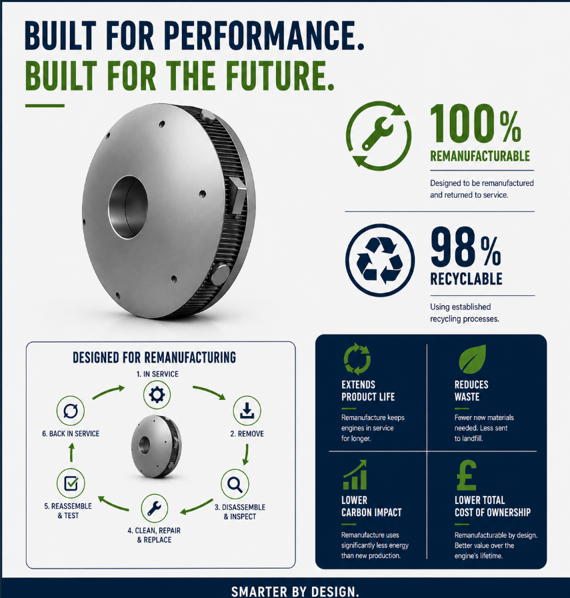
REMANUFACTURE AND RECYCLABILITY.
The Stamoli power unit is being developed with a strong focus on lifecycle sustainability, long-term asset utilisation and circular engineering principles. The architecture is intended to support 100% re-manufacturability, enabling major components and assemblies to be restored, reused, and returned to full operational service. If all else fails, the power unit has up to 98% material recoverability through conventional recycling processes. This approach supports reduced material waste, improved lifecycle value retention and lower long-term environmental impact across transport, power generation, marine, and industrial applications.
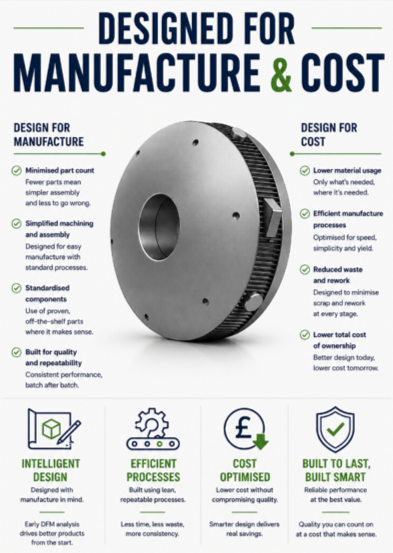
DESIGNED FOR MANUFACTURE & COST.
The Stamoli power unit is being developed with a strong emphasis on design for manufacture, combining engineering principles with practical, scalable production methodologies. While the architecture incorporates precision-engineered components, the design philosophy has intentionally focused on the use of established materials, proven manufacturing processes, and conventional machining techniques. This approach will achieve manufacturability, quality consistency, supply chain accessibility and scalable production without reliance on exotic materials or highly specialised manufacturing technologies. The objective is to balance engineering performance with industrially achievable production methods.
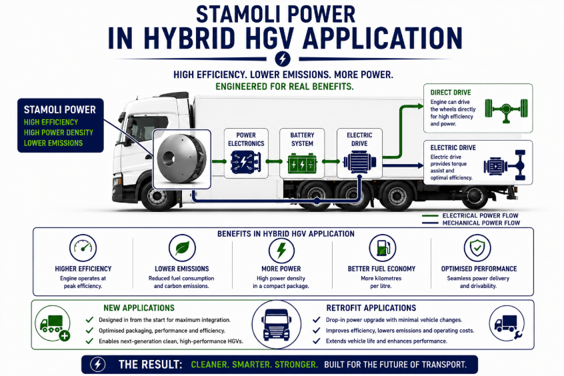
HYBRID POWERTRAIN CONFIGURATION.
The Stamoli power unit is being developed as a fixed-speed range-extender platform for hybrid vehicle applications, particularly heavy goods vehicles operating under demanding duty cycles. Optimised for efficient continuous operation, the engine is intended to provide onboard electrical power generation to support traction systems while reducing dependence on large battery packs and associated charging infrastructure. Continuous onboard charging capability would also significantly reduce depot charging and vehicle turnaround times compared with fully battery-electric commercial vehicles. The architecture is additionally being developed with a direct-drive “get-you-home” capability, enabling mechanical power delivery to the driven wheels in contingency operating scenarios.